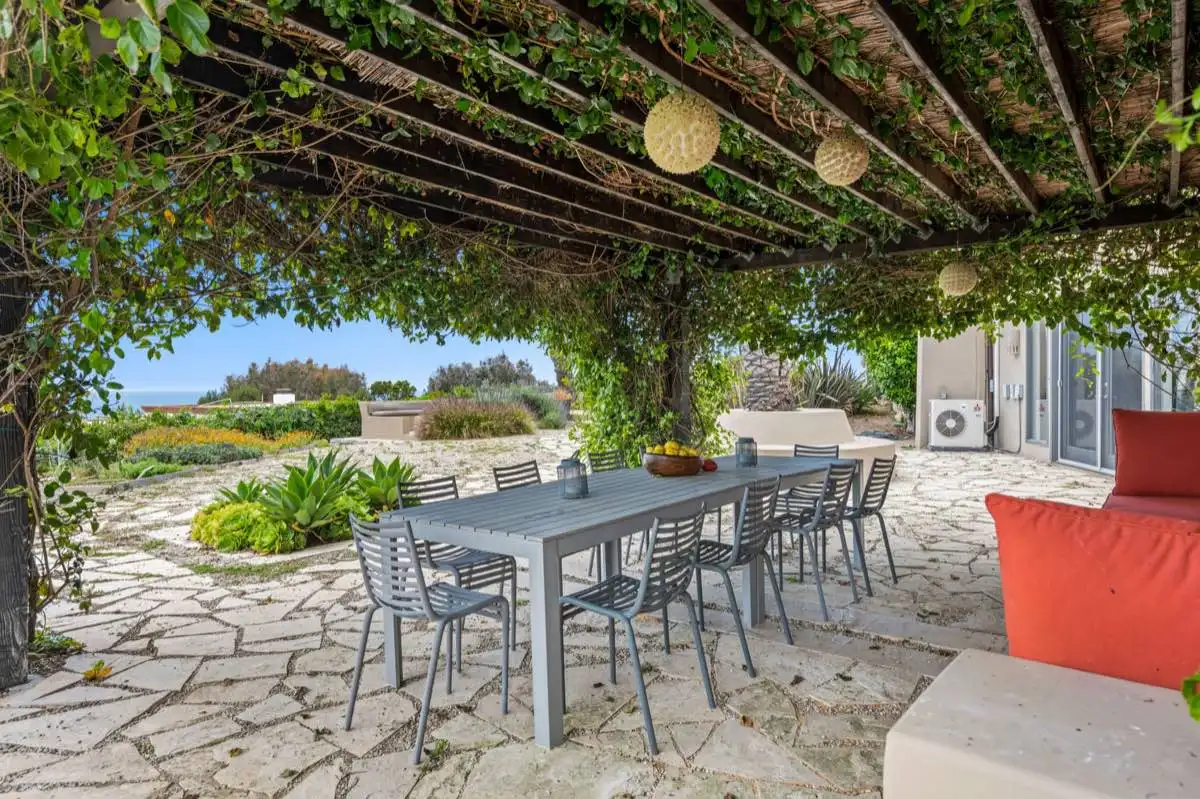
Alumawood is a brand of embossed, powder-coated extruded aluminum built to look like painted wood — no rot, no termites, and no repainting. That's it. That's the product. Everything else you'll read about it is either a benefit of aluminum or a limitation of aluminum, and this page covers both honestly.
The name causes half the confusion in this category. People assume there's wood somewhere in it, or that it's a composite. There isn't and it isn't. It's aluminum wearing a very convincing costume, and the costume holds up from about six feet away, which is where you'll be standing.
What you're actually buying
An Alumawood-style cover is a set of hollow aluminum extrusions — posts, beams, rafters and fascia — with a factory-baked powder coat over an embossed grain texture. The roof deck on top is where the real decisions live:
- Lattice: open blades, roughly 40 to 70 percent shade depending on spacing and blade width, and rain goes straight through.
- W-pan solid: a folded profile that stiffens the deck and drains water down inside the pan. Reaches furthest between beams of the plain pans.
- Flat-pan solid: cleaner-looking from underneath, less inherently stiff, so it usually needs more beams across the same distance.
- Insulated foam-core: a rigid core bonded to both skins. The only one of the three that changes the temperature under the roof rather than just the light.
Those three are specified and priced against each other in our insulated patio cover cost guide. Two spec questions belong here instead, because they are about the extrusion and the finish rather than the deck, and neither appears on a brochure.
Pan gauge. Ask what thickness the roof skins are. It is the easiest place for a cut-rate bid to save money without you noticing, and you find out the answer the first time something lands on it.
Powder coat class. Architectural coatings on aluminum are graded by AAMA voluntary specification in three tiers — 2603, 2604 and 2605 — and the difference between them is weathering, measured by real exposure racks in South Florida rather than by adjectives. AAMA 2603 is validated against one year down there. AAMA 2604 asks for five, with stated limits on color shift and gloss loss. AAMA 2605 asks for ten and is the tier that typically carries a ten-year finish warranty. Most residential patio-cover extrusion is finished to 2603, which is genuinely fine in a mild climate and is also why a south-facing beam in a hard-UV market goes chalky sooner than the sales meeting suggested. In one of those markets, ask which spec the finish meets before you ask about the color.
The honest good list
No rot. Water is the thing that kills wood covers, and it does it from the inside where you can't see it. Aluminum doesn't care.
No termites. Nothing in the structure is food.
No repaint cycle. A powder coat is cured onto the metal in a factory oven, not brushed onto your beams in August. A cedar cover, by contrast, wants cleaning and resealing about every two to three years, forever. Over ten years that's the real cost difference, and it's bigger than the difference in the quotes.
Cool to the touch, relatively. Compared with bare mill-finish aluminum, a light powder-coated finish reflects better and the hollow extrusions hold less heat. It's not cold. It's just not the frying pan people expect from metal.
The honest bad list
Any contractor who tells you the downsides don't exist is selling, so here they are.
It dents. Aluminum extrusion is strong along a span and soft against a point impact. Drop a ladder on a rafter and you'll have a permanent reminder of that afternoon. The good news is that fascia and individual panels are usually replaceable pieces rather than a whole-cover problem.
The color palette is limited. You're picking from a manufacturer's finish list — typically a handful of whites, sandstones, browns and a dark bronze. If you have a specific paint chip in mind, aluminum will not match it, and field-painting a powder coat is a project you'll regret.
Up close, it's metal. The embossed grain is good. It is not cedar. If you and your guests will be sitting three feet from a post all summer noticing that, buy the wood and accept the maintenance calendar. That's a legitimate choice and we'd rather you make it on purpose.
What actually determines whether it holds up
Here's the part that has nothing to do with the brand on the extrusion and everything to do with whether your cover is still there in fifteen years.
What's in the ground, and what's at the wall. Pier depth, standoff bases and above all ledger flashing decide the lifespan of any patio cover, whatever it's made of. There is a grim irony available here: a rot-proof aluminum cover is entirely capable of rotting out the house framing it hangs on, if whoever set the ledger treated flashing as a formality. Those details, with the code sections behind them, are in the pergola vs patio cover breakdown, and the design wind speed that sizes the whole assembly is in the permits guide — including why the figure printed in most brochures is a code cycle out of date.
Fasteners, and the two-metals problem. This one is aluminum's alone. Run a plain steel screw through an aluminum extrusion outdoors and you have assembled a small battery: dissimilar metals plus moisture gives you galvanic corrosion, and aluminum is the metal that loses. Stainless or properly coated hardware throughout, with isolation where aluminum meets anything else structural, is not a detail to leave to whoever happens to be holding the drill.
Thermal movement. Aluminum expands and contracts roughly twice as much as steel over the same temperature swing, and a patio roof sees enormous swings — sun-baked at four, cold by ten. Long runs need slotted or oversized fastener holes so the metal can move. Pin a long fascia solid at both ends and it will relieve the stress on its own terms, usually by oil-canning into a wave you can see from the driveway.
The mistake we get called about
The call comes in as "my patio cover is failing." Nine times out of ten, someone walks out, looks up, and finds a fascia section that's worked loose or a post base with a couple of backed-out lag bolts. That's a $40 hardware fix and twenty minutes with a socket wrench, not a replacement. Tighten it, replace the fastener with the right stainless one, done. If a company looks at a wobbly post base and quotes you a new cover, get a second opinion before you get a new roof.
Genuine replacement territory is different: crushed or buckled beams, a ledger with water damage behind it, or footings that have heaved. Everything else is usually patio cover repair work measured in hours.
The one strong opinion here
Buy aluminum for the structure, and spend your upgrade money on the roof deck instead of the finish. The difference between a basic powder coat and a premium one is a few hundred dollars and a slightly nicer sheen. The difference between a plain pan and an insulated foam-core panel is roughly $10 to $20 a square foot and it changes whether you can sit out there at 3 p.m. in July. One of those you notice every single day. The other you notice during the sales meeting.
If you're weighing open blades against a full deck, our guide to lattice vs solid patio covers walks through the shade and rain tradeoff in detail, and the patio cover cost breakdown has the full pricing ladder.
Bottom line
Alumawood-style covers are the low-drama pick: aluminum strength, a wood-ish look, and a maintenance schedule that consists of pointing a hose at it occasionally. Accept that it dents and that you're choosing from a set palette, put the savings into a better roof deck, and make sure whoever installs it flashes the ledger properly.
Escondido Elite Patio Covers installs powder-coated aluminum and insulated patio covers across Escondido and inland North County San Diego, along with aluminum pergolas when open rafters suit the space better. We'll tell you the panel gauge, the span, and the honest downsides before you sign anything. Call (877) 317-4260.
Ready for a free quote in Escondido?
Escondido Elite Patio Covers — free estimate, clear scope, no pressure. Use the form on this page or jump to the homepage quote.
Related services in Escondido
Escondido Elite Patio Covers money pages — go straight to the service you need.
- Insulated Patio Covers →
Whether a solid insulated roof is worth the money in Escondido depends almost entirely on which way the patio faces. That is not a hedge.
- Alumawood & Composite Covers →
Alumawood is aluminum extrusion, embossed with a grain and finished in wood tones. From below it reads as painted timber.
- Freestanding Pergolas →
The reason to detach a pergola in Escondido is almost always the sun. A house casts nothing useful after three in the afternoon, so the structure has to stand out where the heat lands rather than tucked back against a wall.
- Patio Enclosures →
Say patio enclosure in Escondido and you generally mean a California room: a solid roof with one or two sides left open. Inland that solid roof is not a style preference.
- Retractable & Motorized Screens →
The best-value upgrade on an inland patio is usually a solar drop screen on the west side. It kills the four-to-seven glare that makes a summer afternoon unusable, then disappears when you would rather it did not exist.
Frequently asked questions
What is an Alumawood patio cover made of?
Extruded aluminum, embossed with a wood-grain texture and finished with a baked-on powder coat. There is no wood in it anywhere despite the name and the look. The structural members are hollow aluminum extrusions, and residential roof pans typically use skins in the 0.024 to 0.032 inch range.
Does an Alumawood cover get hot?
Less than bare mill-finish aluminum, because the powder-coated surface reflects better and the extrusions are hollow rather than solid. It still warms up in direct sun. If you want the space underneath to feel genuinely cooler, the upgrade that matters is an insulated foam-core roof panel, not the finish on the beams.
Does Alumawood dent?
Yes. Aluminum extrusion is strong along its span and soft against a point impact, so a dropped ladder, a thrown branch or an enthusiastic basketball can leave a dimple. It's cosmetic rather than structural in most cases, and individual panels or fascia sections can usually be swapped rather than replacing the whole cover.
Do you have to paint an Alumawood patio cover?
No, and that's the main reason people buy it. The powder coat is baked on at the factory rather than brushed on at your house, so there's no two-to-three-year repaint cycle the way there is with a cedar or pine structure. Expect gradual fading over many years of hard UV rather than peeling.
How long does an Alumawood patio cover last?
Decades, with essentially no maintenance beyond an occasional wash. Aluminum doesn't rot, doesn't feed termites and doesn't warp with humidity, which is exactly the failure list for a wood cover. The parts that wear out first are usually the fasteners, the sealant at the ledger, and the finish on south-facing surfaces.
What are the downsides of Alumawood?
Three real ones. The color palette is limited compared with paint, so you match one of the manufacturer's finishes rather than any shade you like. It dents under point impact. And close up, embossed grain reads as textured metal, not as cedar, so if you want the look of real wood you should buy real wood and accept the upkeep.
Is Alumawood cheaper than a wood patio cover?
Usually a little more expensive on day one and much cheaper to own. Figure roughly $20 to $40 a square foot installed for a solid aluminum cover, after which you owe it a hose. A wood cover wants cleaning and resealing roughly every two to three years for the life of the structure.
Local context
How this applies in Escondido, CA
Every article here is written from patio cover work done in Escondido and inland North County San Diego, so the numbers reflect local labour, permit and material costs rather than a national average. Your own job can land either side of them depending on access, the condition of what is already there, and the materials you pick — powder-coated extruded aluminum, embossed wood-grain composite beams, insulated foam-core roof panels.
The way to turn any of this into a real answer is to have someone look at your actual situation. The free estimate is free, itemized and written down, with no deposit and no obligation. Call (877) 317-4260 or start on the Escondido Elite Patio Covers homepage.
Areas Escondido Elite Patio Covers covers
Escondido first, then the surrounding communities of inland North County San Diego. Each has its own page with local detail rather than a copy of this one:
- San Marcos, CA — San Diego County, incorporated in 1963, population 94,833 at the 2020 census
- Vista, CA — San Diego County, incorporated in 1963, population 98,381 at the 2020 census
- Valley Center, CA — San Diego County, unincorporated community, population 10,290 at the 2020 census
- Ramona, CA — San Diego County, unincorporated community, population 21,468 at the 2020 census
- Poway, CA — San Diego County, incorporated in 1980, population 48,841 at the 2020 census
- Rancho Bernardo, CA — San Diego County, a community of the City of San Diego, population part of the City of San Diego
Or jump to the full list of Escondido services.
More from the Escondido Elite Patio Covers blog
- Pergola vs Patio Cover: Which One Fits Escondido?
A pergola is an open-rafter shade structure; a patio cover is a real roof. Which one your Escondido, CA backyard actually needs, and what each costs.
- Patio Enclosure Ideas for Escondido Homes
Patio enclosure ideas from screen rooms to four-season additions, with real costs and the one upgrade that doubles the budget in Escondido, CA.
- Patio Cover Ideas That Actually Get Used (Escondido)
Patio cover ideas ranked by how you'll use the space — solid roof, pergola or shade sail — plus wood vs aluminum vs vinyl and real Escondido, CA costs.
The Escondido Elite Patio Covers Team
patio cover specialists serving Escondido, CA
Written by the Escondido Elite Patio Covers team — insured patio cover pros with 15+ years serving Escondido, CA and the surrounding area.